Thursday, June 19, 2014

Diagram Cable Omron

Omron PLC cable layouts

The PLC's from Omron can be connected to various peripheral equipment. Each device requires its own cable layout. Only the more common cables are shown here.

links

http://ul.to/rza8p0ly

Sunday, July 10, 2011

SIEMENS SIMATIC STEP 7 Professional Edition v5.5 (2010)


SIEMENS SIMATIC STEP 7 Professional Edition v5.5 (2010) | 859 Mb

STEP 7 Professional 2010 - the basic software package, which includes in its membership the tools needed for programming and operation control systems that are based on programmable controllers SIMATIC S7/C7, as well as computer control systems SIMATIC WinAC
The package includes:
* STEP 7 V5.5
* S7-PLCSIM v5.4 SP4
* S7-SCL V5.3 SP5 (Old!)
* S7-GRAPH V5.3 SP6 (Old!)
* S7 Block Privacy (a new method of protecting a user program) manual installation of CD_2 \ Optional Components \ S7 Block Privacy
* S7 Web2PLC (Web interface for remote control of the controller) manual installation of CD_2 \ Optional Components \ S7 Web2PLC

A distinctive feature of the package STEP 7 is the ability to develop complex automation projects based on the use of a set of programmable controllers, industrial computers, devices and systems, human-machine interface devices, distributed I / O, industrial communication networks. Restrictions on the development of such projects are imposed only features programmers or computers that are running STEP 7.

STEP 7 tools allow you to:
* Configure and define the settings of equipment.
* Configure systems of industrial relations and setting parameters of data transmission.
* Programming, testing, debugging and running programs, individual automation systems, as well as their local or remote maintenance.
* Documenting and archiving project data.
* The functions of operational management and diagnostics equipment.
STEP 7 supplied programmers SIMATIC Field PG and SIMATIC Power PG.
It may come as a separate software package for PCs running Windows 7, Windows XP PROF, Windows Server 2003.
S7-PLCSIM - Siemens emulator controller series Simatic, so that for learning to program the controller firm siemens, you do not need to buy this controller

System Requirements / Hardware requirement:
RAM recommended RAM of 2 GB
Compatible with only the 32-bit OS:
Windows 7, Windows XP Professional, Windows Server 2003,
The following operating systems are not supported:
! Windows 95 / 98 / Me / NT / Windows 2000 and Windows Vista are no longer supported!
(Home version of the rules Setup.ini)

Year / Issue Date: 2010/08
Version: v5.5
Developer: SIEMENS AG
Bit depth: 32bit
Compatible with Windows 7, Windows XP, Windows Server 2003: The only x86 (32-bit) / only 32-bit versions
Language: Multilingual (5 european Languages)
Key: Activates a set of keys at the request of ALM or EKB_Install_2010


Part 1,2,3,4,5,6,7,8,9,10, key


What are the requirements for installing STEP 7 version V5.5?
Operating systems
STEP 7 V5.5 is a 32-bit application that can be used with the following operating systems:
· MS Windows XP Professional SP2 or SP3
· MS Windows Server 2003 SP2 / R2 SP2 Standard Edition as workstation computer
· New as of this version: MS Windows 7 32 Bit Ultimate, Professional Enterprise (standard installation). The Windows XP mode under Windows 7 has not been approved yet.

STEP 7 has not been tested for the following operating systems; use at your own risk:
· MS Windows XP Professional with SP1
· MS Windows Server 2003, SP1, SP1 R2
· MS Windows Vista Ultimate, Business and Enterprise
· MS Windows Server 2008 std. Edition SP1 and SP2

Introduction to Control Engineering: Modeling, Analysis and Design

Introduction to Control Engineering: Modeling, Analysis and Design


Author(s):
Ajit K. Mandal
Publisher:
New Age International Pvt Ltd Publishers
Date:
2008-12-01
Format:
pdf
Language:
English
ISBN10:
812241821X
Pages:
632
OCR:

Quality:
excellent
ISBN13:
9788122418217

Product Description: This book is intended for an introductory undergraduate course in control systems for engineering students. This text presents a comprehensive analysis and design of continuous-time control systems and includes more than introductory material for discrete systems with adequate guidelines to extend the results derived in connection continuous-time systems. The prerequisite for the reader is some elementary knowledge of differential equations, vector-matrix analysis and mechanics. Transfer function and state variable models of typical components and subsystems have been derived in the Appendix at the end of the book. Most of the materials including solved and unsolved problems presented in the book have been class-tested in senior undergraduates and first year graduate courses in the field of control systems at the Electronics and Telecommunication Engineering Department, Jadavpur University. MATLAB is the most widely used CAD software package in universities throughout the world. Some representative MATLAB scripts used for solving problems are included at the end of each chapter. The detailed design steps of fuzzy logic based controller using Simulink and MATLAB has been provided in the book to give the student a head start in this emerging discipline. A chapter has been included to deal with nonlinear components and their analysis MATLAB and SIMULINK through user defined s-functions. Finally, a chapter has been included to deal with the implementation of digital controllers on finite bit computer, to bring out the problems associated with digital controllers. In view of extensive use of MATLAB for rapid verification of controller designs, some notes for using MATLAB script M-files and function M-files are included at the end of the book.

Cable INTernet

Bảng tính chọn thông số cáp cho động cơ điện 3 pha

Bảng tính chọn thông số cáp cho động cơ điện 3 pha

Tuesday, June 14, 2011

Fanuc ladder 3 III V5.7 Full

LADDER-III V4.60
SN: p9f3ch-5063572-145562c6
ver 5.0
(SN): KRKA1A-0868235-2FB5FF6F
ver 5.7
SN:J7BB9B-5472992-2F7B766E

Edition 4.90 -> 5.00
In Series 30i/31i/32i-A PMC, PMC Memory C(D address: 20,000 bytes and R addresses: 16,000 bytes) has been supported.
In Series 30i/31i/32i-A PMC, 100,000 ladder steps have been supported.
In Series 30i/31i/32i-A PMC, the maximum capacity of Flash-ROM file has been expanded to 2 MBytes
Multiple address replace function has been added.
In Trace function of Series 30i/31i/32i-A PMC, the multi-path PMC funcion has been supported.
The wheel function of mouse has been supported.
The start number of the data table screen and the extra relay screen of PMC parameter was changed to 0.
In Series 30i/31i/32i-A PMC, the condition of load/store of the PMC parameter was changed.
In Series 30i/31i/32i-A PMC, the application error occurs by the compile of ladder program if some cases of password are set. This problem has been corrected.
Edition 4.80 -> 4.90
The setting of PMC address in 2nd path PMC of Series 30i/31i/32i-A to expand up to the same size as the PMC address in 1st path PMC has been supported.
When the mnemonic file and the external symbol file are output, the zero suppression function of the PMC address is supported.
When the mnemonic file is converted to the source file, the displayed initialization warning message has been improved.
When the error occurs by converting the source of the subprogram, warning of "Subprogram (Pxx) was not created" is output to the log file.
When the address without the symbol/comment/relay comment appears in the first line of the new pages, the line was not printed in the symbol list. This problem has been modified.
Edition 4.70 -> 4.80
- When the extended symbol and comment function was selected for Series 30i/31i/32i-A, the control character of net comment specified in configuration file(%%%FLSET.CNF) was ineffective in source conversion. This problem has been modified.
- In Series 30i/31i/32i-A PMC, the data table setting screen for the extra relay has been supported.
- The "Cut & Paste" of the ladder diagram between the different models has been supported.
- In mnemonic conversion function, each subprogram can be converted into a mnemonic file respectively.
- The ladder program difference display function has been supported.
- In series 30i/31i/32i-A, loading and storing of multi-language PMC message data have been supported.
Edition 4.60 -> 4.70
- In Series 30i/31i/32i-A PMC, the functional instruction PSGNL (SUB50) and PSGN2(SUB63) have been supported
- In Series 30i/31i/32i-A PMC, the Compare instructions (21 kinds) of the functional instruction have been supported.
- In Series 30i/31i/32i-A PMC, the Output function of the external symbol file has been supported.
- The function to easily change the PMC type of ladder program is supported.
- In the online monitor display of PMC-SB7, the elapsed time of functional instruction TMR/TMRB displays 0, and it does not increase. This problem has been modified.
- In Series 30i/31i/32i-A PMC, the allocation data of I/O Unit-B is not converted to the source file. This problem has been modified.
- When the data table of the DISP/COD/CODB instructions has 150 or more data, the program listing will not be displayed correctly if you change the mode to the online. This problem has been modified.
- If the ladder is edited when the window of the "Search result list" is displayed, "Run Time Error" sometimes occurs. This problem has been modified。

http://letitbit.net/download/28237.2af7f931c9062e593f670bc3874d/FLADDER_III_5.7.rar.html

Cable pinout of SIWAREX U Serial cable for calibartion

Wednesday, February 9, 2011

Indirect Addressing in PLC

If you are a C++ programmer then you already know pointers. According to WikiPedia a pointer is a programming language data type whose value refers directly to (or "points to") another value stored elsewhere in the computer memory using its address.

The same concept of pointers is used in PLC but named "Indirect Addressing". When an indirect memory address is specified, the designated memory word will contain the address of the memory word that contains the data that will be used as the operand of the instruction.

To make this more clear let's see an example using OMRON PLC:

1- Direct Addressing :
[url=http://www.servimg.com/image_preview.php?i=128&u=15207678][img]http://i70.servimg.com/u/f70/15/20/76/78/direct10.jpg[/img][/url]

This is an example of direct addressing. When the input "0.00" is on then "5" will be moved to memory word "DM0" directly.
2- Indirect Addressing :
[url=http://www.servimg.com/image_preview.php?i=129&u=15207678][img]http://i70.servimg.com/u/f70/15/20/76/78/indire10.jpg[/img][/url]


The previous image may look like the first one of direct addressing, but if you tried to find the differences between the two images you will notice an asterisk (*) in front of the memory address "DM0". This is indirect addressing. Here, when the input "0.00" is on, the value "5" will not be moved to "DM0" it self but it will be moved to the memory address whose value is stored in "DM0".
For example suppose that "DM0" holds a value of "10", then -simply speaking- the value "5" will be moved to the memory address "DM10".

Indirect addressing will simplify you ladder and make it easy to modify.
As a real example, I was working in a concrete batching plant project which is a plant to produce concrete by mixing different aggregates with cement and water. The recipe page in the HMI software was like this:

[url=http://www.servimg.com/image_preview.php?i=130&u=15207678][img]http://i70.servimg.com/u/f70/15/20/76/78/recipe10.jpg[/img][/url]
There was five set points (Agg1, Agg2, Agg3, Cement and Water) and these five set points are the recipe. There was a slider with values ranging from 0 to 99. The operator of the plant should enter the desired recipe then choose a value on the slider then press "Save Recipe" button to save the 5 set points (recipe) in the chosen location on the slider. To load the saved recipe the operator chooses a value from the slider then presses the button "Load Recipe".


Now how this is done in the ladder diagram using OMRON PLC:
The addresses are as follows:

Slider = DM18
Save Recipe button = 21.12
Load Recipe button = 21.13

If we don't use indirect addressing then the ladder would be like this:

1- Save Recipe :


[url=http://www.servimg.com/image_preview.php?i=131&u=15207678][img]http://i70.servimg.com/u/f70/15/20/76/78/savere10.jpg[/img][/url]
Here when "Save Recipe" button is pressed the slider value is compared to zero and if it equals zero the recipe starting from "DM8" to "DM12" will be saved to addresses "DM1500" to "DM1504".

2- Load Recipe :

[url=http://www.servimg.com/image_preview.php?i=132&u=15207678][img]http://i70.servimg.com/u/f70/15/20/76/78/loadre10.jpg[/img][/url]
Here when "Load Recipe" button is pressed the slider value is compared to zero and if it equals zero previously saved recipe will be loaded from addresses "DM1500" to "DM1504" to addresses "DM8" to "DM12" (the opposite of save operation)

So we used five registers (DM1500 to DM1504) to save and load only one recipe. To save 100 recipes we need 5*100=500 register. If this is done using direct addressing then we need to make 100 compare instructions, 500 move instructions and 100 rung to save recipe and the same numbers to load recipe. Of course this will be very boring and difficult to modify.

Now comes the solution of indirect addressing :

[url=http://www.servimg.com/image_preview.php?i=133&u=15207678][img]http://i70.servimg.com/u/f70/15/20/76/78/savelo10.jpg[/img][/url]

Believe or not, this is only the complete ladder to save and load 100 recipe (500 values are saved and loaded, No move instructions, No compare instructions and very easy to modify).

I decided to save the 500 value in the range of registers from "DM1500" to "DM2000". First the desired starting position in this range is calculated by the following equation:
Desired Save/Load Position = (Slider Value * 5) + 1500
So if the slider position was "0" then the desired save/load position would be:
(0*5)+1500=1500
If the slider position was "99" then the desired save/load position would be:
(99*5)+1500=1995


Then to save and load I used "XFER" instruction which transfers a set of consecutive registers to another set of consecutive registers. The instruction parameters are number of words to transfer, first source word and first destination word.

By using indirect addressing when "Save Recipe" button is pressed, 5 values starting from "DM8" will be moved to another five registers starting from "*DM310" which is the recipe pointer and its value is calculated using the above equation for calculating the desired save/load position.

When "Load Recipe" button is pressed, 5 value starting from "*DM310" will be moved to another five registers starting from "DM8".

Let's see some examples:
1- Slider position = 99
so Desired Save/Load Position=(99*5)+1500=1995
so 5 words from "DM8" to "DM12" will be Saved/Loaded to/from another 5 words from "DM1995" to "DM1999"

2- Slider position = 50
so Desired Save/Load Position=(50*5)+1500=1750
so 5 words from "DM8" to "DM12" will be Saved/Loaded to/from another 5 words from "DM1750" to "DM1754"
and so on.

Finally I hope this article was useful for you.
Good bye.

Automation

Automation is the use of control systems and information technologies to reduce the need for human work in the production of goods and services. In the scope of industrialization, automation is a step beyond mechanization. Whereas mechanization provided human operators with machinery to assist them with the muscular requirements of work, automation greatly decreases the need for human sensory and mental requirements as well. Automation plays an increasingly important role in the world economy and in daily experience.
Automation has had a notable impact in a wide range of industries beyond manufacturing (where it began). Once-ubiquitous telephone operators have been replaced largely by automated telephone switchboards and answering machines. Medical processes such as primary screening in electrocardiography or radiography and laboratory analysis of human genes, sera, cells, and tissues are carried out at much greater speed and accuracy by automated systems. Automated teller machines have reduced the need for bank visits to obtain cash and carry out transactions. In general, automation has been responsible for the shift in the world economy from industrial jobs to service jobs in the 20th and 21st centuries.[1]
The main advantages of automation are:
Replacing human operators in tasks that involve hard physical or monotonous work.[2]
Replacing humans in tasks done in dangerous environments (i.e. fire, space, volcanoes, nuclear facilities, underwater, etc.)
Performing tasks that are beyond human capabilities of size, weight, speed, endurance, etc.
Economy improvement. Automation may improve in economy of enterprises, society or most of humanity. For example, when an enterprise invests in automation, technology recovers its investment; or when a state or country increases its income due to automation like Germany or Japan in the 20th Century.
The main disadvantages of automation are:
Technology limits. Current technology is unable to automate all the desired tasks.
Unpredictable development costs. The research and development cost of automating a process may exceed the cost saved by the automation itself.
High initial cost. The automation of a new product or plant requires a huge initial investment in comparison with the unit cost of the product, although the cost of automation is spread in many product batches.
[edit]Relationship to unemployment


It has been suggested that this section be split into a new article. (Discuss)
[edit]Multivariate effect

This section does not cite any references or sources.
Please help improve this article by adding citations to reliable sources. Unsourced material may be challenged and removed. (January 2011)
Most people consider it common sense that automation has the potential to foster unemployment, because it obviates human work by transferring tasks to machines. However, the translation of that potential into observed effect has largely not happened in the two centuries during which it has been continually predicted. After many decades of automation development and dissemination, the net macroeconomic effect has been generally positive—automation has been part of a general trend of economic growth worldwide; standards of living have risen in many places; and automation has never yet been shown to have induced any widespread structural unemployment. The main explanation for this is that, so far, job losses in any one particular economic niche have always been more than offset by job gains in other niches. As the lowered unit cost of goods and services (which the automation made possible) gave consumers more purchasing power to devote to other goods and services, new jobs sprang up in the production of those goods and services. Thus each time that automation has freed up human resources, those resources have been redeployed by market forces (although it did not always happen without turbulence in the lives of individual workers).
One of the earliest promises of automation was to allow more free time, without any threat of income reduction. This effect has been seen in many individual facets of life (for example, the automatic washing machine has made laundry less time-consuming; engine control units have reduced the amount of automotive downtime; the automatic dishwasher has made dishwashing less time-consuming), but the net outcome of modern life in developed economies remains a state of hurry and busyness, mostly because rising living standards have brought rising expectations in direct relation. (Each time-saving improvement has made room for a new aspiration to take its place.)
Automation also does not imply unemployment when it makes possible tasks that were unimaginable without it (such as exploring Mars with the Sojourner rover). Likewise with fields where the economy is already fully adapted to an automated technology, and the jobs were lost long enough ago that the displacement was long since absorbed by the workforce (as with the continually advancing automation of the telephone switchboard, which eliminated most telephone operator jobs and kept many more from ever existing in the first place).
Today automation is quite advanced (relative to just a few lifetimes ago), and it continues to advance with an accelerating pace throughout the world. Although it has been encroaching on ever more skilled jobs, the general well-being and quality of life of most people in the world (where political factors have not muddied the picture) have improved. Clearly a multivariate effect has been at work (something much more than just the obvious idea that automation has the potential to cause unemployment). In fact, the idea that automation posed an imminent threat to employment, first articulated in 1811 by a group of textile workers known as Luddites, has proven to be so fallacious over the ensuing two centuries that economists call the imminent-threat idea the Luddite fallacy.
There is some concern today that the economy's ability to continue absorbing ever-increasing automation without experiencing significant structural unemployment may be heading toward an upper limit—that is, that we are approaching a point where the Luddite premise will no longer be entirely fallacious, because the relationship of humans to machines that made it fallacious is changing. In this view, the empirical strength of the eternal-fallaciousness idea is only a reflection of the parameter values of the environment thus far. In other words, the idea is undoubtedly an excellent explanation of the past, but whether it can accurately predict the future is an independent problem. Like an investment prospectus, proponents of this view caution that "past performance is no guarantee of future results."
[edit]Timeline of concerns about automation's relationship to unemployment
[edit]Early in the Industrial Revolution
See also: Industrial society and Industrial revolution
Historical concerns about the effects of automation date back to the very beginning of the Industrial Revolution, when a social movement of English textile machine operators in the early 19th century known as the Luddites protested against Jacquard's automated weaving looms.[3] The Luddites destroyed a number of these machines, which they felt threatened their jobs.
[edit]Later in the Industrial Revolution
The development of the American system of manufacturing disgusted many skilled machinists at a time when the very definition of being a machinist included a core element of skilled toolmaking and fitting on a craft basis. Innovations of this system included increasing reliance on jigs and gauges and on machine tools that built more of a process into the tool's movements (such as turret lathes and screw machines). These innovations continually turned skilled work into semi-skilled or unskilled, contributing to vast migrations of laborers across borders and oceans. However, despite this transformation, there were always other economic niches for skilled workers to go to, given enough searching. Recessions interfered with employment, but no foundational aspects of structural unemployment were caused by automation itself.
[edit]During the Machine Age
As in the preceding century, the period of 1880 to 1940 saw no underlying automation-induced structural lack of new economic opportunities for skilled workers to go to, given enough searching,[4] although the Great Depression caused a tremendous disruption to employment. The foundational potential for full employment had not been lost, as would later be shown by the post–World War II economic expansion and other economic miracles.
[edit]During the 1950s through 1990s
See also: Information society and Information revolution
See also: Post-industrial society
The postwar development of new automation technologies using electronics, servomechanisms, and digital computers stoked a new wave of fears similar to the old Luddite ones. Among the working class and labor unions, there was stiff resistance to loss of employment through automation, including contract clauses won in hard-fought contract negotiations that mandated alternate employment for any workers whose positions were eliminated by automation.[5] These clauses seemed a great victory for union workers at large corporations in developed nations, but because they had no effect at smaller, nonunionized companies or in developing nations, those corporations faced withering competition that shrank their market shares until their workers' gains eventually undermined their own success.[5] However, the salvation for employment rates damaged in the industrial sector (secondary sector of the economy) came from the service sector (tertiary sector), which absorbed all of the workers that automation displaced elsewhere. For example, many manufacturing jobs left the United States during the 1990s but were offset by a one-time massive increase in IT jobs at the same time. And in some cases the freeing up of the labor force allowed more people to enter higher skilled managerial jobs and technically specialized jobs, which are typically higher paying. Therefore, fears of unemployment due to automation were generally dismissed as just another instance of the Luddite premise, which had proven fallacious time and again over many decades. Given this obvious empirical contradiction of the premise, people who nevertheless returned to it were usually viewed by the mainstream as cranks misled by quixotic leftist political bias. For example, works by scholars including David F. Noble[6] and Jeremy Rifkin[7] were often respected but discounted. At worst, they were mocked with the disparaging label "neo-Luddite". Noble even wrote a later book titled Progress Without People: In Defence of Luddism[8] to try to further explain why the Luddite premise should not be laughed out of academia.
[edit]Post-market musings
Rifkin's End of Work,[7] published in 1995 and written by a non-engineer, predicted automation-induced unemployment despite having a rather hazy idea of how IT would evolve over the next decade. (The book mentioned the Internet once in passing and the World Wide Web not at all. Its IT focus was mostly on robotics.) Also hazy was Rifkin's explanation of any solution to the problem. The book's subtitle called the solution a "post-market economy", but its concluding chapters did not clearly lay out how such an economy could be engineered, leaving readers to conclude that a non-market solution involving a planned economy was implied between the lines.
In terms of political economy implications, there was no clear differentiation at the time between the ideas of authors like Noble or Rifkin (on the one hand) and traditional leftist agitation (on the other hand). To the extent that readers could ask "What point is this guy getting to?" and answer the question with "socialism" or "a welfare state", they dismissed these authors.
[edit]During the 2000s and 2010s
Since the 1990s, the possibility has been raised again in even an apolitical, technocratic way that the Luddite premise (that automation creates unemployment) was only fallacious in the absence of highly advanced and ubiquitous automation, which until recently was mostly out of reach technologically. This would explain why it has always been fallacious until now, but also why it might not always remain so. For example, Marshall Brain,[9] Martin Ford,[10] and others have suggested that exponentially accelerating information technology (IT) may ultimately result in widespread structural unemployment, because an implicit assumption underlying the "eternally fallacious" idea (that lots of regular humans will always find ways to do service work that machines can't do) will itself be fallacious as IT advances. They suggest that, unlike in the 20th century, when the tertiary sector absorbed all of the workers that the automation of the secondary sector expelled, the tertiary sector now also faces depopulation via automation; its employment will shrink, not grow, and this time there is no other sector to backstop the process by absorbing the displaced workers. The high unemployment rates of the late-2000s recession have brought the idea of structural unemployment back into mainstream attention, as observations are made about positions that require extensive specialized skill and experience standing long vacant even while general unemployment rates above 9% (and horror stories of fruitless job searches) would seem to suggest that such vacancies ought to be scarcer. The idea that automation has finally advanced to the point that the Luddite premise is no longer entirely fallacious is one of the components of some theoretical explanations for the string of jobless recoveries in developed economies in recent decades. Expectations that the (already eroding) fallaciousness will fall off sharply in coming decades underlie the fear of structural shift.[11][12]
Writers such as Rifkin,[7] Brain,[9] and Ford[10] often suggest that the structure of the economy will have to shift to a basic income because its present structural foundation (trading labor for income) will no longer be an available option on a full employment basis. It would perhaps be available to only 90% of workers in the next decade, perhaps 75% of workers a decade after that, and so on. Often included in the basic income idea is an element of civic obligation, such that able people must somehow contribute civically in order to receive the basic income. The labor-market economy (trading labor for income) already achieves that outcome today (because working for income generally produces civic value in various ways, directly and indirectly), but the argument is that advanced automation will decouple the linkage that makes that possible. Thus the same result (trading civic value for income) would have to be driven by different forces—either non-market ones, or via a new kind of market. The non-market idea seems infeasible given the generally abysmal performance record of planned economies. But the idea of engineered new markets leaves room for the disciplining and motivating powers that make capitalist markets capable of positively shaping human behavior where government alone is usually unable.
[edit]New-market engineering
Brain[9] and Ford's[10] books, in stark contrast to Rifkin's, came later and were written by engineers with extensive under-the-hood knowledge of modern production methods, computer hardware and software, and the Internet. They explicitly reject non-market solutions as unworkable and instead suggest new kinds of markets. Rather than being "post-market" proponents, such authors could be called "new-market" proponents. They vigorously distance themselves from socialism or welfare states—generally seeking to keep a market economy with private enterprise, which they believe cannot be preserved unless its foundation is modified from its current structure. Thus, quite contrary to being anti-market agents (as critics might suppose them to be), they believe themselves to be salvaging markets from destruction. They envision creating consumer purchasing power by some other mechanism than the traditional labor market as we have known it so far, in order that free markets may continue to provide the invisible hand component of production-possibilities decisions. In other words, they believe that market forces are necessary to generate allocative efficiency, and they believe that without a structural modification that (at least partially) decouples purchasing power (and consumer confidence) from employment determined by the traditional labor market, there will be a systemic market failure, which they seek to avoid.
Just as new-market advocates are pro-market and pro-private-property, they are also very much non-Luddite (in fact, exactly opposite of Luddite) in the respect that they like technology—they don't hate it. They want it to continue advancing as robustly as ever. They simply feel that income and purchasing power must be decoupled from human participation in production. (The decoupling does not have to happen all at once; it could start small and gradually increase.) If that happens, then they essentially do not have any problem with technology or automation, per se. In contrast to old-style welfare, they do not feel that income should be unconditional, or equal, or "free" (given out "for nothing"). They believe that people should have to work for it (in a new sense of the word "work"), in the respect that they are given incentives to do positive things, like take classes, read books, conserve (or remediate) environmental resources, and so on. People would be paid to do civically valuable things, and if they chose not to do those things, they would not be paid. In this way, new-market advocates align themselves with human nature, which generally requires selfish motivations and incentives to shape behavior, and with the market's invisible hand, which is needed to make the right production-possibilities decisions (because the idea that individual human managers, or groups of them, are capable of making those decisions correctly with zero invisible-hand assistance has been empirically discredited).
Discussions of new-market ideas usually lead to the topic of post-scarcity economic paradigms. But new-market engineers argue that without clear-eyed, realist engineering of the intermediate steps, there is an abyss of dysfunction and hardship between today's economy of scarcity and the starry-eyed goal of any fully developed economy of abundance.
[edit]Wage-recapture market variant
Ford's main new-market mechanism would be to create a tax that recaptures most (not all) of the value that firms and their customers gain from eliminating wages, then use the tax revenue to pay people for doing civically valuable actions—that is, pursuing activities, such as higher education or environmental preservation, that have positive externalities.[10] The main reason for paying these "wages" need not be their altruistic or environmentalist components; the main reason is simply to prevent the market economy from collapsing due to noncirculation of value (that is, the lack of adequate trade which would occur if lack of consumer purchasing power and confidence left no way for an adequate mass market to exist). Ford points out that the tax could not take all of the gains away from the corporations and their customers, because this would destroy the natural incentive to innovate that a market economy needs to be sustainable. The value would be split between the innovators, their customers, and the rest of the population, because leaving out any of that trio would wreck the sustainability of the model. (The leaving out of the third leg is what is causing today's economic pathologies and promising tomorrow's, in the view of new-market engineers.) Ford's idea is an earnest market effort because it preserves the invisible hand as the maker of production-possibilities decisions for goods and services. However, it does rely on human planning (via a technocratic government agency in each country) to make the production-possibilities decisions for civic actions. The latter is viewed as unfortunate but necessary due to the lack of an alternative.
[edit]Mirror-image market variant
Another idea for a new-market mainspring which solves the aforementioned "lack of an alternative" problem is a "mirror image" idea, which has an even more private-sector approach in which the invisible hand helps make even the civic-actions production-possibilities decisions. In this model, the government does not collect a wage-recapture tax at all. Instead of enforcing tax payment, it only enforces payment of a new-style "wage" directly from corporations to consumers that looks to us today like something we might label "mandatory philanthropy", but which would actually be a true market wage of a new type. In today's old market, money flows from consumers, through (partially automated) companies, past the eyes of the government enforcement sentry (but not through its hands) as wages, into the hands of workers (who are also the consumers, thus completing the cycle of value recirculation). In the new market (mirror-image variant), money would flow from consumers, through (highly automated) companies, past the eyes of the government enforcement sentry (but not through its hands) as [new-style] "wages", and into the hands of [new-style] "wage" earners, who are paid the "wage" for civically valuable actions. (They are also the consumers, thus completing the cycle of value recirculation).
In this model, the decisions about what the civic actions are can be made by the invisible hand, because each "mandated philanthropist" gets a large degree of authority in what actions their "philanthropy" (which is actually [functionally] a new-style "payroll") will or won't pay for. Many such paymasters functioning simultaneously could constitute the "buyers" in a market for civically valuable actions (with mass-market "workers" as the "sellers"). There would still be some regulation involved, because, for example, it would be illegal to base the "payroll" decisions on race, color, religion, creed, gender, sexual orientation, ethnicity, disability, marital or veteran status, and so forth. To decide which "workers" were on a given "payroll", there might be a clearinghouse to randomly match the two, rotating assignments every several years. Or perhaps the businesses that run the "payroll" could even "hire" the "workers" themselves, in which case workers would compete for "jobs" by showing off how "productive" they could be in doing the civic actions (another level of invisible hand yet again). The "mirror image" name comes from the idea that this variant of new market is a very free market where the invisible hand remains just as powerful as it was in the 1945-2008 economy, but with many mirror-image aspects (which are visualized above by the amount of quotation marks that are necessary to signify mirror-image senses for words that were always [up till now] widely known only in their non-mirror-image senses).
The axis of reflection in the mirroring seems to be, at root, a "polarity shift" from where human individuals can add value only by doing production (from within production systems) to where they can also add value by avoiding hurting production systems (from outside). The hurt-avoidance comes from such civic actions as providing goods-and-services demand via consumption (which the system requires in order to stay running) instead of failing to consume (because of lack of income); ensuring the sustainable supply of energy and environmental resources to the production systems (by avoiding overconsuming those); and ensuring the supply of people educated enough to provide the few humans that the production systems will need in the future, by pursuing education and cognitively enriching pastimes. The humans that the systems need will be few, but those few will need to be highly intelligent, talented, and educated, constituting a human resource that might be endangered if the general population does not act as a "farm team system" for it by valuing education and self-education as a civic action. An analogy is provided by sports' relationship to general life. Few humans are talented and practiced enough to play professional sports, but the professional teams rely on a system that filters such scarce people out of the general population via little league/pee wee programs, high school play, college play, farm-team play, etc. People in the general population are not considered inferior human beings (versus the pro players) because of their lack of pro talent. They are valued as the fans and ticket-buyers that make the pro system economically viable. And a small fraction of them grow up to become pros themselves.
In today's old market, governments enforce the payment of wages by having outlawed their nonpayment (i.e., slavery); by levying tariffs on cheap competition from countries that kept their nonpayment (slavery) (that outlawing has now been global for many decades); and by attempting to minimize their underpayment (i.e., wage slavery, a sharply cheapened value of work [with elites and their customers keeping the money]). In the new market (mirror-image variant), governments enforce the payment of "wages" by outlawing their nonpayment (i.e., evading the "payroll"); by levying tariffs on cheap competition from countries that kept their nonpayment (non-participating countries); and by attempting to minimize their underpayment (i.e., "wage" slavery, a sharply cheapened value of civic actions [with elites and their customers keeping the money]).
One of the inherent challenges of the mirror-image variant is that various forms of dressing up corporations' financial self-interest in a specious cloak of civic virtue would inevitably arise. This would be a "washing" form of marketing and operations that included greenwashing and analogous washing in other domains of life (e.g., education, infrastructure). It seems unlikely that this can be entirely negated; instead, it would have to be perennially pruned by social censure and regulatory oversight. However, no other system is without its chronic weaknesses, either. For example, the classical variants of capitalism (implemented thus far) have scored poorly on various tests, such as environmental sustainability and (potentially) the employability of the average human (as that was traditionally defined) as automation grows pervasive. Twentieth-century variants of communism fared even worse in environmental sustainability, and also failed economically in average standard of living and politically in individual freedom. The wage-recapture new-market variant, with its technocratic decisions on how to spend the revenue, holds promise to minimize the corporate "washing" problem, yet it also holds risks of failing on allocative efficiency and market-driven innovation, which the mirror-image variant mitigates. As elsewhere in reality, each choice has pros and cons, rather than any choice being perfect. The "washing" problem may be the mirror-image analog of classical capitalism's tendency to exaggerate needs (for example, a maker of antibacterial soaps encouraging the populace to fear microbes to an irrational degree). Both are forms of conflict of interest that cause "chronic irritation" to a socioeconomic system but need not be "fatal" to it if given adequate "medical management". The washing problem may be less systemically injurious than the allocative inefficiency problem, just as the "exaggerated needs" problem of classical capitalism was less systemically injurious than the allocative inefficiency problem of central economic planning.
In choosing the decider of production-possibilities decisions (whether of goods, services, or civic actions), the invisible hand is generally preferred to committees of humans because it has proven to be superior at the decision making (except for regulatory issues such as race-color-religion-etc and the "washing" discussed above). In the future it will also be necessary to ask what role artificial intelligence might possibly have in making those decisions, and whether humans would allow it. Perhaps artificial intelligence, like human intelligence, will share the role with the invisible hand but be barred from usurping the entirety of it.
[edit]Implementations
Regarding the chances of any new-market ideas being implemented, there are both significant barriers and significant drivers, with a net potential of perhaps "even chances". Ford[10] discusses many of these barriers and drivers. The barrier side includes (a) natural cultural conservatism that powerfully resists systemic changes; (b) the powerful influence of laissez-faire ideals, which would resist any engineered systemic change to markets (especially anything involving a tax); (c) the fact that early implementation by individual countries faces an immediate threat from the export and offshoring competition of countries that haven't yet implemented; and (relatedly) (d) the all-or-nothing problem, which may occur if a new system would work well but only if the switch from old to new was an off-on switching rather than a gradual evolution. However, on the driver side there are powerful forces that may answer all of the barriers. Foremost would be a dawning realization by economic elites that they have a choice between a new market with prosperity, or the old market spiraling into near-total failure. Globalization so far has not threatened the wallets of economic elites (only those of average workers), and has in fact enriched the elites thus far; but the changing parameter values of the economic system as automation advances would alter that runtime environment and transform it into a new one, where even the elites' wealth would be threatened by a market failure that killed their businesses and reduced asset values throughout the economy. Realizing these options, elites might actually switch from opposing new markets to actively supporting their implementation (including addressing the competition between countries whose policies differed). The all-or-nothing problem does not have to occur if an implementation is engineered such that extremely profitable, extremely automated industries began piloting new markets while other industries continued with an old-market status quo for quite some time. In this model, the early adopters voluntarily become leaders, and the pilot projects would act simply as economic stimulus on the broader economy (although a type of stimulus much more effective than old-style stimulus, whose efficacy seems to be eroding because it relies on the Luddite premise being a total fallacy as opposed to shifting by degrees out of total fallaciousness). The overall transition in this model could actually be quite painless, as a generally prosperous economy changed gradually over decades from mostly-old-with-some-new to mostly-new-with-some-old. The selfish motivation of the early-adopter leaders would be the aforementioned choice faced by economic elites. They would choose to stimulate the broader economy because that result would ensure their own continuing strong sales and growth by preserving a runtime environment of general prosperity for them to operate within, without which depression or malaise would occur.
Given the aforementioned choice faced by economic elites, those in the private sector might even choose to pursue the new market without government involvement. But the private sector faces two hurdles that would make it difficult: the natural competition between firms (which is necessary and thus must be protected by competition law), and legal obligation to maximize shareholder value. The traditional definitions of shareholder value evolved in an earlier era whose commercial environment had different parameter values due to lack of advanced automation. Those traditional definitions would bar new-style payrolls. But in the face of market failure without them, perhaps a case would emerge for an updated definition. Competition is the other hurdle. Companies are barred by competition law from agreeing to limit competition, and even if they weren't, individual companies generally cannot make the first move of increasing expense without being killed by competition from rivals who don't. This is why "a level playing field" would have to be created by policy, or to use a different analogy, "a high tide that lifted all boats equally". This is directly analogous to existing minimum wage laws. Individual companies generally could not survive in the market if they volunteered to self-enforce minimum limits on wages (in the absence of any laws requiring them). There is breathing room for above-market wages (e.g., to attract superior talent) at some companies in some industries who enjoy a relatively high level of imperfect competition; but most companies in most industries face competition too close to pure to survive the attempt. In this sense, the mandated value recirculation (whatever anyone calls it, from "wage recapture" to "new-style wages") is as unremarkable and non-novel an idea as any legislative or regulatory mechanism in commerce. For goals that make long-term systemic balance possible but cannot be pursued by the self-interest of individual market players, these mechanisms provide a path by forcing all competitors to play the game by the same rules. Existing examples include employment standards (e.g., child labor laws, minimum wage laws), environmental protection, and financial regulation (to prevent bubbles and thus crashes). These exist in perennial tension with the forces of pure capitalism; thus the extremes perform checks and balances on each other. Businesses usually fight for inadequate regulation; government usually fights for excessive regulation; and a sustainable balance results. Over decades, systemic pathologies gradually push the balance point out of the sustainable range; periodic breakdowns then yield correction by counteractive forces (e.g., trust-busting [leftward correction], the Reagan revolution [rightward correction]).
Laissez-faire ideals reigned supreme worldwide for about three decades (roughly centered on the fall of the Soviet Bloc, which vindicated capitalism over central planning in many ways). In this environment, where the lesson commonly extrapolated was that pure capitalism will always be better than any mixed-economy alternatives, the prevailing theory has been that higher corporate taxes can only harm economic prosperity. The reasoning is partly that countries can simply compete to undercut each other's corporate tax rates (which is true), but also, more importantly, that only the invisible hand is capable of recirculating capital back toward the base of the economy in a successful manner (which is not to be dismissed lightly, and may in fact be true). The disparaging label for such ideas is "trickle-down economics", but many intelligent people have earnestly believed in these ideals; and the fact that their discounting has often been facile and done by imperfect opponents has only encouraged believers to stay faithful. Widespread fervor for trickle-down beliefs (in both the public and private sectors) poses a formidable barrier to the wage-recapture-tax new-market variant. But these conventional beliefs rely on the assumption that the Luddite premise is entirely and eternally fallacious. Unfortunately, there has already been a decade of empirical evidence that low taxes, new business investment, and economic growth no longer have a sure-fire correlation to strong, "good-jobs" employment in developed economies.[13][14][15] If the Luddite premise has been starting to shift into partial accuracy, then no amount of continued low taxes and deregulation will ever be able to produce enough trickling down to create broad-based prosperity. In that case, mandating the payment of new-style wages could recirculate value back to the base of the mass market. The promise of the mirror-image variant would be that humans need not turn to taxes for the value recovery (at the top) nor to central planning for the distribution details (at the bottom). As long as the "minimum wage" (referring to the new-style wages) and other employment standards are being enforced, then government's role ends there.
Conceivably, both the Luddite premise and the lump of labor premise could change states in continuous-graph fashion, from completely false to partially true, depending on parameter values in the commercial environment, most specifically, the available modes of value recirculation. In this view, for two centuries they were completely false or very nearly so, because the traditional labor market provided sufficient means of value recirculation. As that fails because of advanced automation, they could enter partial influence. But if new forms of broad-based personal income came into being (for example, basic income, guaranteed minimum income, or new-style wages), they could revert back to a state of complete or near-complete falsehood again. The difference would be that enough value was circulating broadly enough through a mass market of consumers and corporations that services which today could not possibly garner middle-class wages and benefits (for example, full-time jobs reading stories to hospitalized children, painting murals, or attending university) would become viable at that wage level.

Tuesday, November 30, 2010

PTC Pro Engineer Wildfire 5.0


PTC Pro Engineer Wildfire 5.0 F000 x86 Full - ISO


PTC Pro Engineer Wildfire 5.0 F000 x86 Full - ISO | 3.59 GB


SAD / CAM / CAE System American company PTC (Parametric Technology Corporation) is a CAD system of the upper level and covers all areas of design, technological preparation of production and manufacturing. Wide range of three-dimensional modeling apparatus, the high quality of the result and its stability to subsequent changes made by the system of Pro / ENGINEER by one of the leaders in CAD / CAM / CAE-systems, and have direct access to the system life cycle support product Windchill PDMLink translates Pro / ENGINEER WILDFIRE the category of PLM-systems.

Year: 2010
Print: WF4 M130
Developer: PTC
Platform: Win x32
Compatibility with Vista: complete
Language: English
Tabletka: Present

System requirements:

Memory: 1Gb or more
CPU speed: 2.4GHz or higher
Disk Space 3Gb or more

New features:

- Working with large assemblies: reduction to 40% of the volume occupied by the memory, the use of multi-thread in the CPU and the consequent reduction in the time of the upgrade in large assemblies.
- Associative Interface MCAD-ECAD.
- Selective dynamic change of data (technology IDX).
- Simulation of ribbon cables: a new menu for new objects: parameters of the ribbon cable when modeling in 3D, «crook", "kink", "pass through"; decomposition of the cable within a single ribbon cable, alignment and binding tape along the cable laying.
- Export diagrams of Pro / ENGINEER (Pro / DIAGRAM) in the RSD: export to a neutral format: Connectors, conductors, cables, labels, tables, layers, etc.
- 3D-annotation of drawings.
- Automated rounding edges (Auto-Round).
- New ability to remove surface when designing injection molds; simplify the geometry by removing small and insignificant elements of the model.
- Import Data Doctor - a new mechanism to facilitate fuller use of models and data from external CAD.
- Direct editing of surfaces: control points editing the history of editing, support for multiple editing sessions on the same parts of complex shape.
- Rendering: HDRI (High Dynamic Range Imaging) function for the light, reflection and background, the dynamic deployment of textures, rendering the zones ( "regional" rendering); space filling (picture room ").
- Reverse Engineering: better graphics and better performance, automatic identification of "holes" in the facet model; offset facet model; symmetrical building / pruning model.

More information
Code:
http://www.ptc.com/products/proengineer/

links full
http://letitbit.net/download/46538.4baa4bac32659ac5fef47bd7f640/PPEWV5F500V32.part02.rar.html
http://letitbit.net/download/35984.3ab4821240f0e9dbc8a3b5abaca9/B0006Y3Y2G_CircuitApplications.rar.html
http://letitbit.net/download/43515.4a1daef67a451778ac4b7447e3d7/PPEWV5F500V32.part12.rar.html
http://letitbit.net/download/48180.49885087b82ffc9e5609f69bf154/PPEWV5F500V32.part18.rar.html
http://letitbit.net/download/42722.405911ee9602273d1a3d9c6804f0/PPEWV5F500V32.part21.rar.html
http://letitbit.net/download/2139.2d91006152afaa03c8a512d92/PPEWV5F500V32.part19.rar.html
http://letitbit.net/download/78975.75b5767eae26ca0c6bbd2762dbfc/PPEWV5F500V32.part20.rar.html
http://letitbit.net/download/1164.af1aa41fc23dc987a83cbc001/PPEWV5F500V32.part16.rar.html
http://letitbit.net/download/1150.1faf61ac0e0745c748348fbd2/PPEWV5F500V32.part05.rar.html
http://letitbit.net/download/7193.7e01c46be8a1ac04cb19e2f41/PPEWV5F500V32.part14.rar.html
http://letitbit.net/download/4130.45cb952765bca62d4d0a5a132/PPEWV5F500V32.part17.rar.html
http://letitbit.net/download/2192.2f4bbb0570ec0dfdea301734f/PPEWV5F500V32.part13.rar.html
http://letitbit.net/download/1160.a157bfca85735dba76588894b/PPEWV5F500V32.part11.rar.html
http://letitbit.net/download/2186.dfda235795d0c8dfe91edfb76/PPEWV5F500V32.part01.rar.html
http://letitbit.net/download/0130.d09341fee0d62003a2b4d792f/PPEWV5F500V32.part08.rar.html
http://letitbit.net/download/5169.a5082c8a6584c7562546753f4/PPEWV5F500V32.part06.rar.html
http://letitbit.net/download/5182.a5018ea3504cc600e2f456458/PPEWV5F500V32.part04.rar.html
http://letitbit.net/download/8160.84540aea81120eaa866a9b94f/PPEWV5F500V32.part07.rar.html
http://letitbit.net/download/5189.5182912dd40fee2c375888a11/PPEWV5F500V32.part09.rar.html
http://letitbit.net/download/0132.d0a804a2d789ec8b9b9e6985e/PPEWV5F500V32.part10.rar.html
http://letitbit.net/download/9135.ae97d5d456471080fca2bc797/PPEWV5F500V32.part03.rar.html

Tuesday, November 23, 2010

Siemens_Simatic_Step5_V7.23

Simatic S5 PLC
From Wikipedia, the free encyclopedia
The Simatic S5 PLC is an automation system based on Programmable Logic Controllers. It is manufactured and sold by Siemens AG. Such automation systems control process equipment and machinery used in manufacturing. This product line is considered obsolete, as the manufacturer has since replaced it with their newer Simatic S7 PLC. However, the S5 PLC still has a huge installation base in factories around the world. Most automation systems integrators still have the ability to provide support for the platform.
Contents [hide]
1 Hardware
2 Software
3 Structured programming
4 Methods of representation
5 Blocks
6 Operations
7 Additional functions
8 External references
[edit]Hardware

The S5 line comes in the 90U, 95U,101U,100U, 105, 115U, 135U, and 155U chassis styles.Higher the number, the more sophisticated and more expensive the system. Within each chassis style, several CPUs are available, with varying speed, memory, and capabilities. Some systems provide redundant CPU operation for ultra-high-reliability control, as used in pharmaceutical manufacturing, for example.
Each chassis consists of a power supply, and a backplane with slots for the addition of various option boards. Available options include serial and Ethernet communications, digital input and output cards, analog signal processing boards, counter cards, and other specialized interface and function modules.
[edit]Software

The S5 product line is usually programmed with a PC based software programming tool called Step 5. Step 5 is used for programming, testing, and commissioning, and for documentation of programs for S5 PLCs.
The original Step 5 versions ran on the CPM operating system. Later versions ran on MS-DOS, and then versions of Windows through Windows XP. The final version of Step 5 is version 7.2. No further development of this product line has occurred since that time, due to its announced obsolescence.
In addition to Step5, Siemens offered a proprietary State logic programming package called Graph5. Graph5 is a sequential programming language intended for use on machines that normally run through a series of discrete steps. It simulates a State machine on the S5 platform.
Several third-party programming environments have been released for the S5. Most closely emulate Step5, some adding macros and other minor enhancements, others functioning drastically differently than Step5. One allows Step5 programs to be cross-compiled to and from the C programming language and BASIC.
[edit]Structured programming

STEP 5 allows the creation of structured or unstructured programming, from simple AND/OR operations up to complex subroutines. A STEP 5 program may, therefore, contain thousands of statements.
To maintain maximum transparency, STEP 5 offers a number of structuring facilities:
Block technique - A linear operation sequence is divided into sections and packed into individual blocks.
Segments - Within blocks, fine structuring is possible by programming subtasks in individual segments.
Comments - Both a complete program as well as individual blocks or segments and individual statements can be directly provided with comments.
[edit]Methods of representation

STEP 5 programs can be represented in three different ways:
Statement List (STL) - The program consists of a sequence of mnemonic codes of the commands executed one after another by the PLC.
Ladder Diagram (LAD) - Graphical representation of the automation task with symbols of the circuit diagram
Function Block Diagram (FBD) - Graphical representation of the automation task with symbols to DIN 40700/ DIN 40719.
Absolute or symbolic designations can be used for operands with all three methods of representation.
In LAD and FBD complex functions and function block calls can be entered via function keys. They are displayed on the screen as graphical symbols.
==
[edit]Blocks

Five types of blocks are available:
Organization blocks (OB) - for managing the control program
Programming blocks (PB) - contain the control program structured according to functional or process-oriented characteristics
Sequence blocks (SB) - for programming sequential controls
Function blocks (FB) - contain frequently occurring and particularly complex program parts
Data blocks (DB) - for storing data required for processing the control program.
Some S5 PLCs also have block types FX (Extended Function Blocks), and DX(Extended Data Blocks); these are not distinct block types, but rather are another set of available blocks due to the CPU having more memory and addressing space.
[edit]Operations

STEP 5 differentiates between three types of operations:
Basic operations, (e.g. linking, saving, loading & transferring, counting, comparing, arithmetic operations, module operations) - These can be performed in all three representations.
Supplementary operations and complex functions, (e.g. substitution statements, testing functions, word-by-word logic operations, decrement/increment and jump functions.) - These can only be executed in STL.
System operations (direct access the operating system) - These can only be executed in STL.
[edit]Additional functions

Saving user-specific project settings
Symbol editor
Automatic generation and updating of cross-reference lists
Comparison of user programs
Transferring blocks to EPROM and EEPROM memory modules for programmable controllers
Rewiring inputs, outputs, flags, timers and counters
Testing and service functions for startup and maintenance
[edit]External references

Siemens S5 to S7 Migration
Hans Berger - Automating with SIMATIC - ISBN 978-3-89578-333-3
Hans Berger - Automating with SIMATIC S7-1200 - ISBN 978-3-89578-356-2
Juergen Mueller - Controlling with SIMATIC - ISBN 978-3-89578-255-8
Direct-Industrial - Continued Support for European Siemens Simatic S5 Users

http://letitbit.net/download/78900.732c71fa06df1c4e39fe13a03fff/Siemens_Simatic_Step5_V7.23_Completo___Crack_Seriale___S5_Manuals_(PLC).iso.html

Hiren's Boot CD for USB Bootable 12.01


Hiren's Boot CD is a boot CD containing various diagnostic programs such as partitioning agents, system performance benchmarks, disk cloning and imaging tools, data recovery tools, MBR tools, BIOS tools, and many others for fixing various computer problems. It is a Bootable CD; thus, it can be useful even if the primary operating system cannot be booted. Hiren's Boot CD has an extensive list of software. Utilities with similar functionality on the CD are grouped together and seem redundant; however, they present choices through UI differences. Hiren's BootCD - All in one Dos Bootable CD which has all these utilities.

Обновлённые программы:
+ ATF Cleaner 3.0.0.2: A personal and easy-to-use temp file removal software to clean all user temp folders, Java cache, Opera/Mozilla browser cache, cookies, history, download history, saved passwords etc (Windows Freeware).
+ Avira AntiVir Personal (07-11-2010): Free anti-virus and anti-spyware on-demand scanner, detects and removes more than 50000 viruses (Windows Freeware).
+ BIOS Master Password Generator: Collection of password generator tools to reset BIOS Power on Password / Admin password on Dell, Fujitsu Siemens, Compaq, Hewlett Packard, Phoenix and Samsung Laptops (Windows Freeware).
+ Duplicate File Finder 3.5: Scans and identify duplicate files, it compares them based on byte for byte comparison ensures 100% accuracy (Windows Freeware).
+ Everything 1.21: Ultra fast file/folder search tool with ftp/http server (Windows Freeware).
+ GoldMemory 5.07: Memory Diagnostic Tests (Dos Shareware).
+ HDD Low Level Format Tool 2.36: Low-level format tool for S-ATA (SATA), IDE (E-IDE), SCSI, USB, Flash Cards and FIREWIRE external drive enclosures (Windows Freeware).
+ HashMyFiles 1.68: Calculate MD5/SHA1/CRC32 hashes of your files (Windows Freeware).
+ ImgBurn 2.5.2.0: Lightweight CD/DVD/HD DVD/Blu-ray burning application, supports BIN, CUE, DI, DVD, GI, IMG, ISO, MDS, NRG and PDI, Ability to build DVD/HD/BD Video discs from a VIDEO_TS/HVDVD_TS/BDAV/BDMV folder, Unicode folder/file names (formerly DVD Decrypter) (Windows Freeware).
+ Macrium Reflect 4.2.2952 (MiniXp): Create complete backups of your disk partitions, including operating system, installed programs and all your settings (Windows Freeware).
+ NTPWEdit 0.3: Password editor for Windows NT based systems to change or remove passwords for local system accounts (Windows Freeware).
+ On-Screen Keyboard: A utility that displays a virtual keyboard on the computer screen that allows people with mobility impairments to type data by using a pointing device or joystick (Windows Freeware).
+ RKill (24-10-2010): RKill just kills malware processes, imports a Registry file that removes incorrect file associations and fixes policies that stop us from using certain tools (Windows Freeware).
+ Revo Uninstaller 1.90: Remove unnecessary files and registry entries left behind by incomplete program uninstallation routines (Windows Freeware).
+ RunAsDate 1.10: allows you to run a program in the date and time that you specify (Windows Freeware).
+ Seagate DiscWizard 11.8326: Backup drive/partition to an image file, for Seagate owners (Powered by Acronis TrueImage) (Windows/Linux Freeware).
+ ServiWin v1.40: Alternative Windows Services/Drivers Tool (Windows Freeware).
+ ShadowExplorer 0.7: Shadow Explorer allows you to browse the shadow copies created by the Windows Volume Shadow Copy Service and retrieve older versions from files you accidentally deleted or altered (Windows Freeware).
+ SpaceSniffer 1.1.2.0: Find lost space on your disks the easy way (Windows Freeware).
+ WinSCP 4.2.9: A free and open source SFTP/FTP client to secure file transfer between a local and a remote computer (Windows Freeware).

7-Zip 9.18b, BootICE 0.80.6, CCleaner 3.0, CPU-Z 1.56, ComboFix (07-11-2010), Dr.Web CureIt! Antivirus (07-11-2010), FastCopy 2.04, GPU-Z 0.4.7, GParted Partition Editor 0.7.0, HBCD Program Launcher 1.9, Malwarebytes Anti-Malware 1.46 (07-11-2010), PCI 32 Sniffer 1.4 (07-11-2010), PCI and AGP info Tool (07-11-2010), Process Monitor 2.93, PuTTY Tray 0.60 r3, RIPLinux 11.1, SIW 2010.10.21, ShellExView 1.48, Speccy 1.06.191, Spybot - Search & Destroy 1.6.2 (07-11-2010), SpywareBlaster 4.4 (07-11-2010), SuperAntispyware 4.45.1000 (07-11-2010), TeamViewer 5.1.9385, USBDeview 1.81, UnknownDevices 1.4.20 (07-11-2010), grub4dos 2010-11-04, isolinux 4.03

MD5 F09523AA9B65876AA960B36B003E2440
Hiren's Boot CD for USB Bootable 12.01
Sizer: 360 mb

links
http://letitbit.net/download/69675.6a04bcebd0b9512060968e71f1fb/HirensBootUSB_12.part3.rar.html
http://letitbit.net/download/57697.51a16b4c694871a4b5a6843d9600/HirensBootUSB_12.part2.rar.html

http://letitbit.net/download/71172.7cf8f4dd31637361aa7836e72a1b/HirensBootUSB_12.part1.rar.html

Sunday, November 21, 2010

Process Identification and PID Control


Author(s): Su Whan Sung, Jietae Lee, and In-Beum Lee
Publisher: Wiley-IEEE Press
Date: 2009 Format: PDF Language: English ISBN10: 0470824107
Pages: 1 OCR: Quality: Good ISBN13:

Process Identification and PID Control enables students and researchers to understand the basic concepts of feedback control, process identification, autotuning as well as design and implement feedback controllers, especially, PID controllers. The first The first two parts introduce the basics of process control and dynamics, analysis tools (Bode plot, Nyquist plot) to characterize the dynamics of the process, PID controllers and tuning, advanced control strategies which have been widely used in industry. Also, simple simulation techniques required for practical controller designs and research on process identification and autotuning are also included.

Part 3 provides useful process identification methods in real industry. It includes several important identification algorithms to obtain frequency models or continuous-time/discrete-time transfer function models from the measured process input and output data sets. Part 4 introduces various relay feedback methods to activate the process effectively for process identification and controller autotuning. •Combines the basics with recent research, helping novice to understand advanced topics •Brings several industrially important topics together: •Dynamics •Process identification •Controller tuning methods •Written by a team of recognized experts in the area •Includes all source codes and real-time simulated processes for self-practice •Contains problems at the end of every chapter •PowerPoint files with lecture notes available for instructor use

links http://letitbit.net/download/3169.38d3e4566225ebcdbf84d1c15/0470824107.rar.html

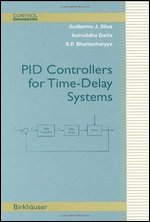
PID Controllers for Time Delay Systems,1 edition


Author(s): Guillermo J. Silva, Aniruddha Datta
Publisher: Birkhauser Boston
Date: 2004 Format: PDF Language: English ISBN10: 0817642668
Pages: 400 OCR: Quality: ISBN13:

The Proportional-Integral-Derivative (PID) controller operates the majority of modern control systems and has applications in many industries; thus any improvement in its design methodology has the potential to have a significant engineering and economic impact. Despite the existence of numerous methods for setting the parameters of PID controllers, the stability analysis of time-delay systems that use PID controllers remains extremely difficult and unclear, and there are very few existing results on PID controller synthesis.

Filling a gap in the literature, this book is a presentation of recent results in the field of PID controllers, including their design, analysis, and synthesis. The focus is on linear time-invariant plants, which may contain a time-delay in the feedback loop---a setting that captures many real-world practical and industrial situations. Emphasis is placed on the efficient computation of the entire set of PID controllers achieving stability and various performance specifications---both classical (gain and phase margin) and modern (H-infinity norms of closed-loop transfer functions)---enabling realistic design with several different criteria. Efficiency is important for the development of future software design packages, as well as further capabilities such as adaptive PID design and online implementation.

Additional topics and features include:

* generalization and use of results---due to Pontryagin and others---to analyze time-delay systems

* treatment of robust and nonfragile designs that tolerate perturbations

* examination of optimum design, allowing practitioners to find optimal PID controllers with respect to an index

* study and comparison of tuning techniques with resepct to their resilience to controller parameter perturbation

* a final chapter summarizing the main results and their corresponding algorithms

The results presented here are timely given the resurgence of interest in PID controllers and will find widespread application, specifically in the development of computationally efficient tools for PID controller design and analysis. Serving as a catalyst to bridge the theory--practice gap in the control field as well as the classical--modern gap, this monograph is an excellent resource for control, electrical, chemical, and mechanical engineers, as well as researchers in the field of PID controllers.

links http://letitbit.net/download/5163.59ab509c339bee3fa8c8381e7/0817642668PIDControl.rar.html

Monday, November 1, 2010

ProfiCAD v6.1.4


ProfiCAD is the quickest and easiest way to create electrical documentation and schematic diagrams. Although it is very easy to learn and use, it is a professional tool used by a wide range of customers.

Features of ProfiCAD - electrical diagrams editor
• easy to learn and use - just drag symbols onto the drawing
• low system requirements - runs on any PC with Windows 2000 and higher
• supports Unicode - can use any language, any technical symbol
• ships with cca 700 symbols - new symbols can be easily created
• downloads quickly, installs quickly, starts quickly, takes 5MB on hard drive and can be run from a flash drive
• automatic update - always have the latest version
• continuous numbering of symbols
• intelligent renumbering of symbols when copying
• automatic save - saves your documents automatically
• generates netlist and bill of material
• generates list of wires and calculates total of lengths
• title blocks editor - create your owns for easy reuse
http://letitbit.net/download/85094.896f53fc6cdc49d10968508bc174/ProfiCAD.v6.1.4-SHOCK.rar.html

or
http://www.ziddu.com/download/12341956/ProfiCAD.v6.1.4-SHOCK.rar.html

Renewable Energy in Europe: Markets, Trends and Technologies


Author(s): European Renewable Energy Council
Publisher: Earthscan Publications Ltd.
Date : 2010
Pages : 272
Format : PDF
OCR :
Quality :
Language : English
ISBN-10 : 1844078752
ISBN-13 :

How can the European Union meet its commitment to derive 20% of its energy from renewable sources by the year 2020? Which sources offer the best prospects for realizing this goal? These are the questions answered by this key book which analyzes the current situation of renewable energy in Europe, examines the latest technological, financial and economic developments, and outlines ways in which the markets themselves can be developed.
The book is divided into sections examining the integration of renewable energy, electricity, heating and cooling, and biofuels. All the main technologies are covered, with exploration of:
* benefits and applications
* costs and prices
* markets and installed capacity
* policy instruments
* key countries and success stories
* targets and long-term potential.
This will be essential reading for policy decision-makers at all levels and to all those involved in the development of the renewable energy industry.

links http://letitbit.net/download/1151.114facb6a359eaeb64a5bca58/1844078752Renewable_EnergyB.pdf.html

Saturday, October 30, 2010

Delcam-ArtCAM 2010 new


catia v5r19 sp5


DSS CATIA V5R19 SP5 Update Only | 1.13 GB
Genre: Graphics & Design

CATIA V5 is the leading product development solution for all manufacturing organizations, from OEMs through their supply chains to small independent producers. The range of its capabilities allows CATIA V5 to be applied in a wide variety of industries, such as aerospace, automotive, industrial machinery, electrical, electronics, shipbuilding, plant design, and consumer goods, including design for such diverse products as jewelry and clothing.
Attention! Its only service packs! To install them, you must have already preCATIA V5R19!

Year: 2010
Version: V5R19 SP5
Developer: DASSAULT SYSTEMES
Platform: Windows
Compatibility with Vista: complete
Compatible with Windows 7: complete
Language: Multilingual
Medicine: Present (TeamSolidSQUAD)
links
http://letitbit.net/download/1142.138792110771ae14a940b7e8c/SP5_for_CATIA_v5r19.part02.rar.html
http://letitbit.net/download/5198.d57fb3bce7f272f5e015dbb53/SP5_for_CATIA_v5r19.part01.rar.html
http://letitbit.net/download/2118.2a4c8dcd0cbebc83cc10b7e31/SP5_for_CATIA_v5r19.part05.rar.html
http://letitbit.net/download/4114.4c6eeeb22c36464043b02765c/SP5_for_CATIA_v5r19.part07.rar.html
http://letitbit.net/download/6181.61253eb98fc839e1db6fba72d/SP5_for_CATIA_v5r19.part08.rar.html
http://letitbit.net/download/7135.d713fa0b480d9301849ec8f6f/SP5_for_CATIA_v5r19.part03.rar.html
http://letitbit.net/download/9145.9b86ec1ddff5cc44197ffc118/SP5_for_CATIA_v5r19.part06.rar.html
http://letitbit.net/download/2163.241572cce454e7035a141386b/SP5_for_CATIA_v5r19.part09.rar.html
http://letitbit.net/download/3193.b33a0f66a1ab5e0c939be774d/SP5_for_CATIA_v5r19.part10.rar.html
http://letitbit.net/download/8138.8e967b257670714d6fc741440/SP5_for_CATIA_v5r19.part04.rar.html

Tuesday, October 26, 2010

Das grosse PIC-Mikro Handbuch. Auf CD-ROM: MPLAB, PIC-Programme, Beispielcode


Author(s): Anne Konig, Manfred Konig
Publisher: Franzis
Date : 2007
Pages : 330
Format : PDF
OCR :
Quality : Good
Language : English
ISBN-10 : 3772342655
ISBN-13 :

Dieses Buch richtet sich an Interessenten, die bereits erste Erfahrungen mit PIC-Microcontrollern gesammelt haben. Der Schwerpunkt liegt auf den neuen Entwicklungen der letzten Jahre. Dazu zahlt naturlich in erster Linie die PIC18-Generation, die mit dem 16-Bit-Kern nicht nur hoheren Programmierkomfort, sondern vor allem eine Fulle neuer technischer Moglichkeiten bietet. Aber auch von den PICs mit 14- bzw. 12-Bit-Kern gibt es viel Neues zu berichten.
Die Autoren haben viele Jahre Erfahrung mit industriellen PIC-Micro-Projekten. Sie behandeln das Thema aus der Sicht ihres Entwickler-Alltags. Dazu gehort alles, was um die PIC-Microcontroller herum von Bedeutung ist. Das sind z. B. die analogen Peripheriebausteine und die Entwicklungsumgebung, bestehend aus MPLAB inklusive der Debugger und den Demoboards.

http://letitbit.net/download/14943.157d2a1749923c6d10afb1d746b1/3772342655PICMicro.rar.html

Electrician's Troubleshooting and Testing Pocket Guide, 3 Edition


Electrician's Troubleshooting and Testing Pocket Guide, 3 Edition by Brooke Stauffer, John Traister
MGH | 2007 | ISBN-10: 0071487824 | 208 Pages | PDF | 14 MB

The ultimate electrical equipment troubleshooting pocket guide
Designed for quick reference at any job site, the Electrician's Troubleshooting and Testing Pocket Guide enables electricians using portable meters to test, maintain, and troubleshoot all types of electrical equipment and systems. . .
This updated classic now features:. .
Expert guidance on all the latest troubleshooting tools, testing instruments,. systems, and equipment.

Time-saving charts, tables, and diagrams for assuring quality and. safety compliance .
Vital material on personal protective equipment (PPE) required for testing. energized circuits.
NEW material: coverage of new equipment, such as infrared scanners and power quality analyzers; information and guidelines that comply with new NFPA 70E safety requirements

links http://www.fileserve.com/file/APaYPKu